Tracklist on next page








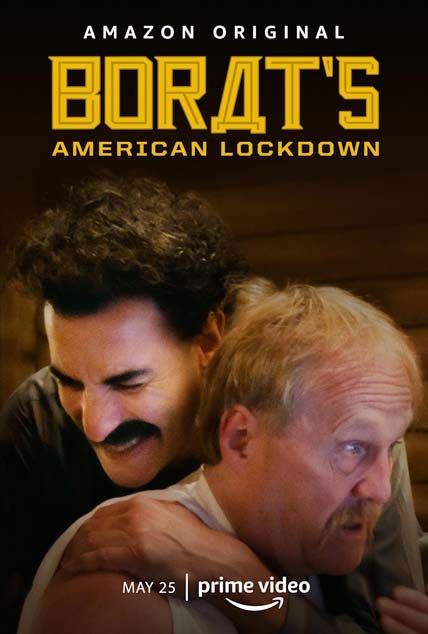
Live the real-life drama of Sacha Baron Cohen, as Borat Sagdivev, where he spends five days at the peak of the Covid-19 pandemic with two conspiracy theorists. Then, in Debunking Borat, see the two conspiracy theorists have their theories debunked by some of the world’s leading experts.

After being sent to a sinister religious retreat by their stepfather, two siblings fight to escape in order to save their mother from harm’s way.

When wreckage from a destroyed alien spacecraft scatters across the Western Hemisphere, it soon becomes apparent the pieces are messing with the laws of physics, changing lives in ways we can’t comprehend. Two agents from different continents, and different mindsets, are tasked to work together to recover the debris, whose mysteries humankind is not quite ready for.

In Philadelphia, Billy Batson is an abandoned child who is proving a nuisance to Child Services and the authorities with his stubborn search for his lost mother. However, in his latest foster home, Billy makes a new friend, Freddy, and finds himself selected by the Wizard Shazam to be his new champion. Now endowed with the ability to instantly become an adult superhero by speaking the wizard’s name, Billy gleefully explores his new powers with Freddy. However, Billy soon learns that he has a deadly enemy, Dr. Thaddeus Sivana, who was previously rejected by the wizard and has accepted the power of the Seven Deadly Sins instead. Now pursued by this mad scientist for his own power as well, Billy must face up to the responsibilities of his calling while learning the power of a special magic with his true family that Sivana can never understand.

Dieses Fachbuch beschäftigt sich mit der Flexibilität und Umnutzungsfähigkeit von Büro- und Geschäftshäusern aus objektplanerischer, konstruktiver, ökonomischer und ökologischer Sicht und zeigt die relevanten Parameter für die Gebäudestruktur auf, die eine Umnutzung in andere Gebäudetypen wirtschaftlich und somit nachhaltig machen. Dies geschieht mit dem Fokus auf Gebäude, die in Stahl- und Verbundbauweise konstruiert sind.

Europe is inseparable from its history. That history has been extensively studied in terms of its political history, its economic history, its religious history, its literary and cultural history, and so on. Could there be a distinctively philosophical history of Europe? Not a history of philosophy in Europe, but a history of Europe that focuses on what, in its history and identity, ties it to philosophy.
In the two volumes of Europe: A Philosophical History – The Promise of Modernity and Beyond Modernity – Simon Glendinning takes up this question, telling the story of Europe’s history as a philosophical history.
InPart 1, The Promise of Modernity, Glendinning examines the conception of Europe that links it to ideas of rational Enlightenment and modernity. Tracking this self-understanding as it unfolds in the writings of Kant, Hegel and Marx, Glendinning explores the transition in Europe from a conception of its modernity that was philosophical and religious to one which was philosophical and scientific. While this transition profoundly altered Europe’s own history, Glendinning shows how its self-confident core remained intact in this development. But not for long. This volume ends with an examination of the abrupt shattering of this confidence brought on by the first world-wide war of European origin – and the imminence of a second. The promise of modernity was in ruins. Nothing, for Europe, would ever be the same again.
Part 2: Beyond Modernity is available now from Routledge. In the wake of two world wars of European origin, Europe’s modern promise of universal peace, freedom and well-being for all humanity lay in ruins. In Part 2, Beyond Modernity, Glendinning picks up the story of this promise after the Second World War. Taking in Isaiah Berlin’s defence of a pluralist ideal, Francis Fukuyama’s vision of a new ‘end of history’ in liberal democracy, and Jacques Derrida’s critique of the very idea of an end of history, Glendinning invites us to affirm a new philosophical-historical self-understanding: not the history of the rational animal on the way to its final end, with Europe at the head, but a history of the unpredictably self-transforming animal without a final end. In this context, Glendinning argues, Europe remains promising, its cosmopolitan heritage opening a future beyond its exhausted modernity.

We’re in the midst of an AI research explosion. Deep learning has unlocked superhuman perception that has powered our push toward self-driving vehicles, the ability to defeat human experts at a variety of difficult games including Go and Starcraft, and even generate essays with shockingly coherent prose. But deciphering these breakthroughs often takes a Ph.D. education in machine learning and mathematics.
This updated second edition describes the intuition behind these innovations without the jargon and complexity. By the end of this book, Python-proficient programmers, software engineering professionals, and computer science majors will be able to re-implement these breakthroughs on their own and reason about them with a level of sophistication that rivals some of the best in the field.
New chapters cover recent advancements in the fields of generative modeling and interpretability. Code examples throughout the book are updated to TensorFlow 2 and PyTorch 1.4.
The 2nd edition of The Practice of Chinese Medicine: The Treatment of Diseases with Acupuncture and Chinese Herbs describes the application of traditional Chinese medical theory to the diagnosis and treatment of 48 diseases, conditions and disorders. In addition to the existing 34 covered in the first edition, 14 new conditions and symptoms have been added, and these include common, chronic, and acute conditions which clinicians may see in their practice.
Most of us know what it feels like to fall under the spell of food when one slice of pizza turns into half a pie, or a handful of chips leads to an empty bag. But it s harder to understand why we can’t seem to stop eating even when we know better. When we want so badly to say “no,” why do we continue to reach for food?